There Is a Graveyard Most Game Developers Never Talk About
Not a literal one.
A folder.
Usually named something like "Projects", "Ideas", or "Games_2023_final_v2."
Full of Unity projects that never made it past the first week. Godot scenes with placeholder cubes. Concept docs that were exciting on a Tuesday and abandoned by Thursday.
We had that folder too.
Every developer does.
But at some point we had to be honest about why projects were ending up there — and what we could actually do about it.
This is the story of how Kufrashe Technologies learned to ship.
The Approach That Wasn't Working
For a long time, the process looked like this:
Brainstorm → Find an idea that sounds great → Start the project → Motivation dips → Pause it → Graveyard.
The problem with that approach, if we're being completely honest, was that the ideas we were generating sounded great in our heads but were almost always AAA-scale concepts.
Open-world games.
Deep narrative RPGs.
Massive multiplayer experiences.
Things that would take teams of hundreds and budgets of millions to execute properly.
Where did those ideas come from?
Partly from what we knew and played.
But also—and this is the part nobody talks about—from watching too much YouTube.
Not tutorial hell.
Not the kind where you can't make anything without following a step-by-step guide.
A different kind.
The kind where you watch developers making demos and prototypes and calling them games. Where the content is always "Let's brainstorm what to make today." Where the creative process looks easy, exciting, and frictionless.
It isn't.
And when you try to replicate it, you end up with a graveyard.
What Actually Saved Us
Before I was making original games, I was making mods.
ETS2.
Wrestling Revolution 3D.
Full maps, custom trucks, accessories, complete content additions built inside someone else's game.
No blank canvas.
No "What should I make today?"
Just:
Here is a system that exists.
Here is something missing from it.
Here is how I would build it.
That experience gave me something most developers who start from scratch don't have—the ability to think about mechanics and ideas on the fly, without forcing them, with full creative control but within real constraints.
When I eventually started making original games, that instinct came with me.
The Corn Sprite That Became MAGNETIC
MAGNETIC—our first publicly shipped game—did not start as a game about magnetic forces.
It started as a question.
What if you didn't control the player character directly?
What if you controlled a secondary object, and the player followed that object?
At one point, MAGNETIC was actually about farming.
Growing and harvesting crops.
I had a fork-like item and a corn sprite—2D, simple, placeholder—and I was trying to make the farming mechanic feel interesting.
It wasn't resonating.
Something was off.
Then a random thought:
What if the corn was attracted to the fork?
I prototyped the mechanic.
The corn moved toward the fork.
The player followed.
Obstacles appeared.
Collectibles spawned.
A game loop emerged—not from a brainstorm session, not from a YouTube video about game design, but from a corn sprite and a question asked in the middle of a prototype that was going nowhere.
That's how MAGNETIC was born.
Navigate a world using a mouse-controlled proxy object.
Your character follows.
Obstacles and collectibles appear randomly.
Simple.
Tactile.
Completely unlike anything else because it came from an instinct, not a formula.
The Approach That Actually Works
If I had to describe how Kufrashe Technologies approaches game development now, it would look like this:
We don't try to find ideas. We assess what we get.
An idea appears—sometimes randomly, sometimes from something we experience, observe, or already know.
We don't force it.
We don't ask "Is this commercially viable?" before we even know whether the mechanic is fun.
We prototype the core feeling first.
If the mechanic resonates, we scope it properly.
Not the full vision.
An MVP.
The smallest version that delivers the core experience completely.
Then we enhance what can be enhanced.
Then we ship.
That discipline—
Scope it. Build it. Ship it.
—is what separates the games in our portfolio from the games in the graveyard folder.
Playing in Our Own Shoes
There is one more thing that drives everything we make.
We put ourselves in the player's shoes.
Not as developers asking,
"Is this technically impressive?"
but as players asking,
"Would I be proud of this experience?"
Most of the other stuff—the reception, the downloads, the recognition—follows after an exceptional game experience.
Chase the experience first.
And wherever possible, we draw from what we know.
Home.
Zimbabwe.
Africa.
The local space is part of what makes our games unique.
We know home best in practice—not theoretically, not from research, but from living it.
That knowledge shows up in our games in ways that can't be manufactured.
MAGNETIC came from a corn sprite and a fork.
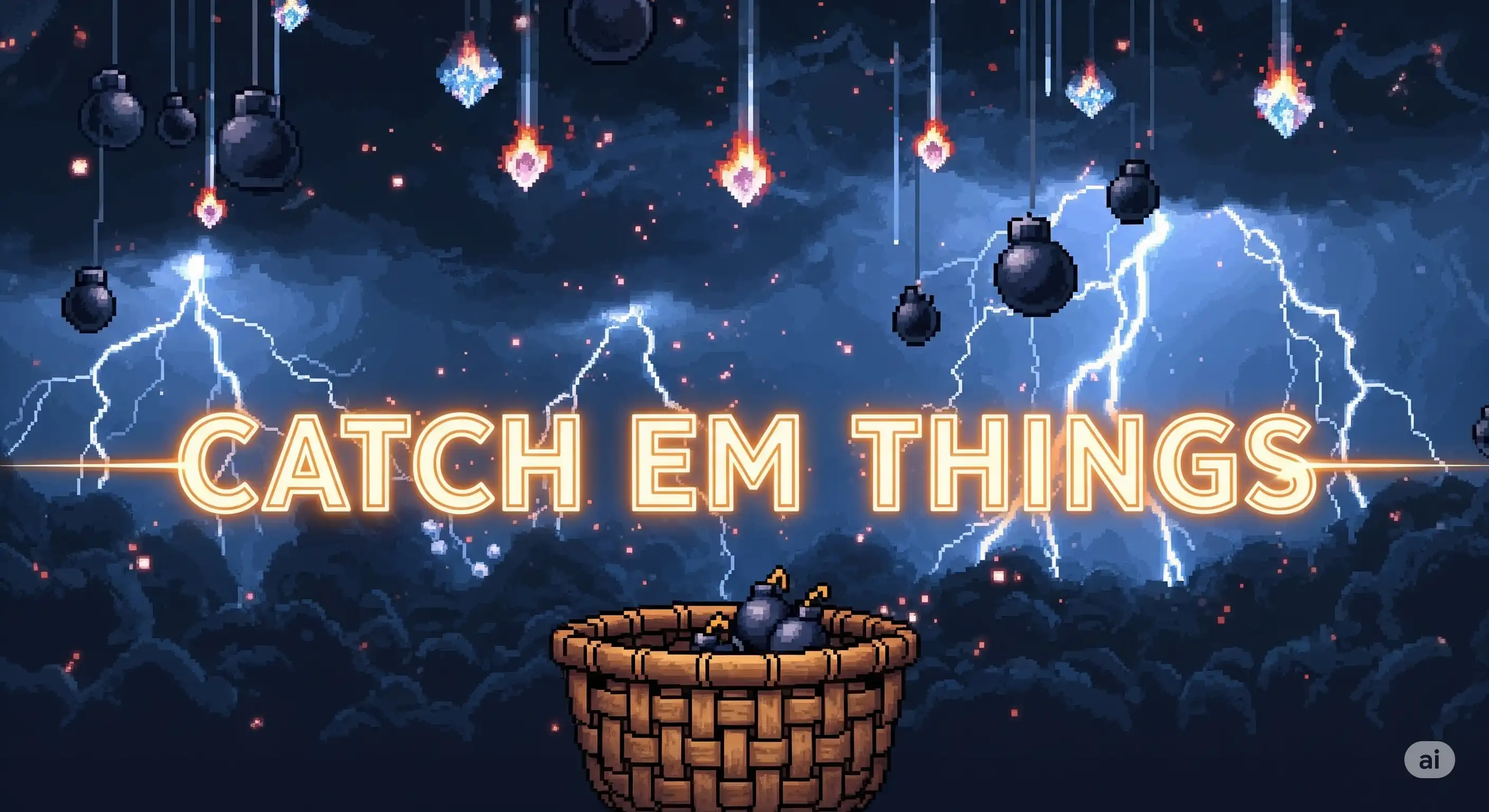
Catch Em Things came from the pure chaos of trying to catch things falling faster than you can think.
The games we're building next will come from somewhere equally unexpected.
That's the approach.
Don't force the idea.
Find the mechanic.
Scope it properly.
Ship it.
Make something you'd be proud to play.
The graveyard folder still exists.
But it's been a while since anything new went in.